
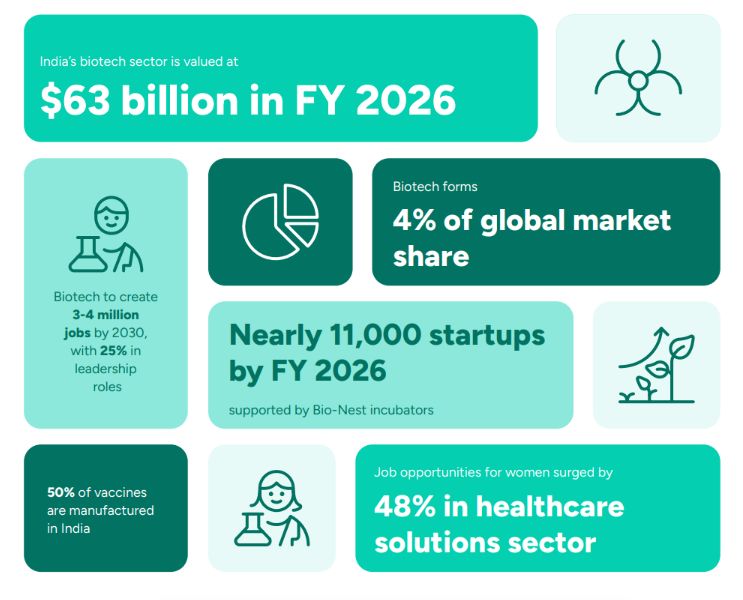
The biotechnology industry in India is rapidly expanding. There is still a huge buzz for biotech careers in India. The country’s bioeconomy hit $195.3 billion in 2025, registering a remarkable 17–18% annual growth and contributing nearly 5% to national GDP. With over 11,800 biotech startups, supportive policies like the BIO-E3 initiative, and a clear roadmap to a $300 billion bioeconomy by 2030, the industry is creating thousands of high-impact jobs every year.
Now here’s the big question that every high school and college student (and their families) are asking: How do I break into this exciting field?
Well, here’s the good news: You don’t have to wait until your master’s degree to get into the field. With the right combination of practical skills and early exposure, you can position yourself ahead of the game — even while you are in high school or early in your college career.
This blog post combines two very important topics: the biotech career opportunities in India and the current/future trends in the job market. Therefore, it will provide you with a complete roadmap for pursuing a career in biotech in India.

Key Roles in India’s Biotech Job Market: What You Can Aim For
Freshers often wonder which roles are realistic right after graduation. Here’s a clear comparison of three high-demand entry-to-mid-level positions (salaries are approximate averages for 2025–26, varying by city, company, and experience):
| Role | Key Skills Required | Typical Entry Salary (₹ LPA) | Growth Potential (3–5 yrs) | Best For Students Who Love… |
|---|---|---|---|---|
| Research Associate | Molecular biology, cell culture, PCR, data analysis, literature review | 3.5 – 7 LPA | 8 – 15 LPA | Lab experiments, discovery, research projects |
| QA Analyst / QC Executive | GLP/GMP compliance, documentation, quality control testing, regulatory basics | 4 – 8 LPA | 9 – 16 LPA | Precision, rules, ensuring product safety |
| Bioprocess Engineer | Fermentation, scale-up, bioreactor operation, process optimization | 5 – 10 LPA | 12 – 20+ LPA | Engineering + biology, manufacturing scale |
Pro tip: Entry salaries in Bengaluru, Hyderabad (Genome Valley), and Pune are 15–25% higher than the national average due to the concentration of GCCs, MNCs, and startups. Read more about Why India’s Global Capability Centers (GCCs) Are a Game-Changer for Pharma, Biotech & Life Sciences Graduates.
These roles are not “just jobs” — they sit at the heart of India’s vaccine, biosimilar, and biomanufacturing revolution.
Emerging Trends Shaping Biotech Careers & Jobs in 2026

The job market is shifting fast. Here are the top three trends every student should know:
Trend 1: Biomanufacturing & Scale-Up (The “Make in India” Engine)
Government policies like BIO-E3 are building national biofoundries and Bio-AI hubs to accelerate indigenous manufacturing of vaccines, enzymes, and bio-based chemicals. Companies need professionals who understand the challenges of scale-up — moving from lab flasks to 10,000-litre bioreactors while maintaining quality and cost-efficiency. Regional hubs like Hyderabad and Bengaluru are leading; startup funding is tilting toward “value-led” biomanufacturing ventures rather than pure discovery plays.
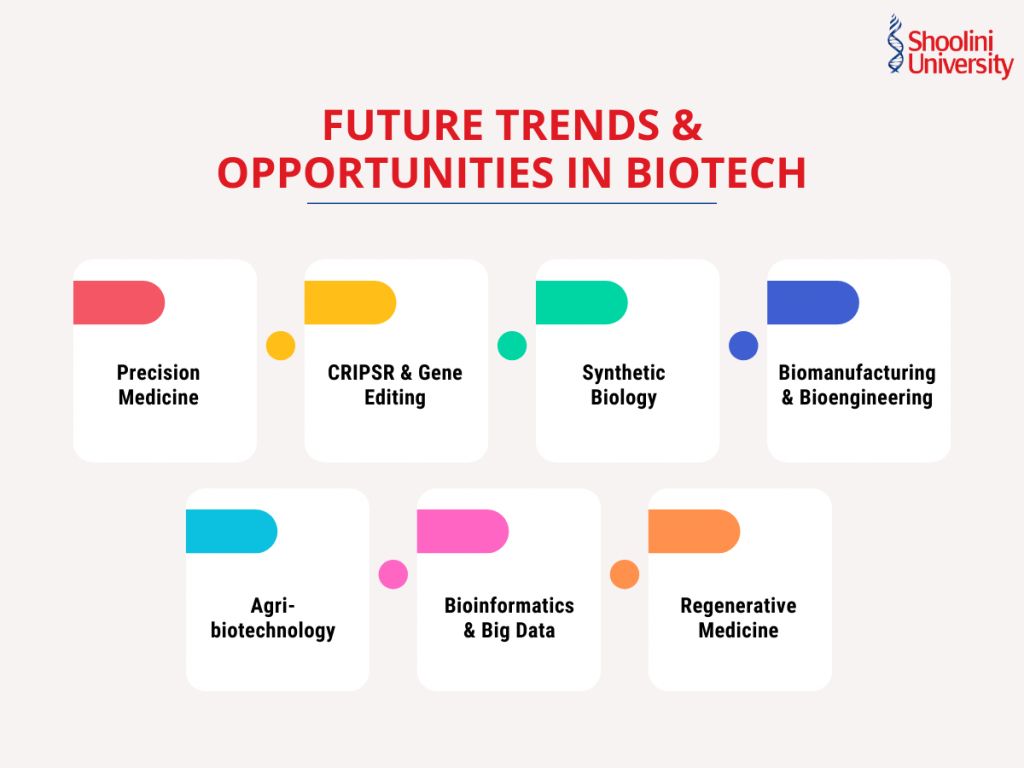
Trend 2: Synthetic Biology & CRISPR Advances
From engineering microbes that produce sustainable materials to precision gene editing for agriculture and therapeutics, synthetic biology is exploding. Ethical considerations around CRISPR are now part of industry conversations. Indian firms are investing heavily, and the demand for trained synthetic biologists capable of strain engineering and bio-design tools is surging.
Trend 3: AI Integration in Drug Discovery & Data Analytics
AI is shortening drug-discovery timelines from years to months. Roles now demand hybrid skills: wet-lab biology + Python, machine learning for genomics, and predictive modelling. The biggest skill gap? Students who can bridge biology and data science. Companies are actively hiring “BioAI” specialists and computational biologists.
Future-proof stat: By 2030, nearly 40% of new biotech roles in India are expected to require AI or computational skills.
Skill Gaps & How Practical Training Bridges Them
Academia teaches theory. Industry demands GLP, GMP, documentation, scale-up thinking, and cross-disciplinary tools. This gap is real — and it’s why many freshers struggle in placements.
My Own Career Journey
After finishing B.Pharm, I knew my passion lay in molecular biology, cardiovascular pharmacology, neuroscience, drug target discovery, and biomarkers.
I had four Master’s admits in the UK. I chose Aston University over higher-ranked options because of its strong subject ranking, small-campus environment, affordable fees (even after partial scholarship), and practical focus.
For my dissertation, I deliberately combined molecular biology, cardiovascular, and neuropharmacology techniques — including cell culture and radioactive work — to make myself job-ready as a fresher. That strategic choice landed me a Research Assistant role at the University of Oxford’s Department of Cardiovascular Medicine.
The lesson? Hands-on, industry-aligned projects early on make all the difference.
Practical Training at SHRM Biotechnologies
SHRM Biotechnologies’ training programs are built exactly for this bridge. Our summer programs and research projects give high school and college students real exposure to molecular biology (DNA extraction, PCR), bioinformatics, AI-aided drug design, microbiology, and more — skills employers crave.
Students and parents have already shown strong interest in our high-school research projects, and the new SHRM Skill and Innovation Foundation (Section 8) will further expand incubation and skill development.
Student Testimonials
“The SHRM summer camp’s PCR and cell-culture sessions were better than my college lab. It helped me crack an internship at a Hyderabad startup.”
— Grade 12 student, 2025 batch
“I never imagined high-school students could work on real bioinformatics projects. SHRM made it possible and gave me a clear career roadmap.”
— College fresher now pursuing B.Tech Biotech
Related Article: Building a Biotech Career from Class 9–12 to Professional: From Early Exposure to Clinical Research Careers
Actionable Steps to Launch Your Biotech Career
- Start Early — Join a summer program or short research project (like SHRM’s 2026 Biosciences Summer Program — offline in Kolkata/Gurgaon or live online).
- Build a Portfolio — Document every lab experiment, dissertation, or mini-project on GitHub or a personal portfolio site.
- Master Must-Have Tools — Learn basic Python/R for data analysis, CRISPR design tools, and GMP/GLP principles.
- Network & Intern — Attend webinars, connect with SHRM alumni, and apply for internships via LinkedIn or company portals.
- Tailor Your Resume — Highlight practical skills and projects, not just theory. Quantify outcomes (“Performed 20+ PCR runs and analyzed data using bioinformatics tools”).
Ready to turn curiosity into a career? Explore SHRM Biotechnologies’ Biosciences Summer Program 2026 (online & offline) research projects and training opportunities in biotechnology.
Whether you dream of discovering the next life-saving drug, scaling biomanufacturing, or using AI to fight disease, the 2026 biotech job market in India is wide open. The students who start building real skills today will lead tomorrow.
Author Bio: Tanmoy Ray is an admission consultant, content strategist, and former research scientist with a global academic portfolio. After earning his Master’s in the UK, he went on to work at the University of Oxford (UK), Utrecht University (Netherlands), and the University of New South Wales (Australia). In 2015, Tanmoy pivoted into higher-education counselling and content marketing. Today, he helps students and professionals navigate admissions abroad while producing insight-rich content for career growth.