
When students think about biotechnology careers, they often imagine something distant and complicated. Research labs. Scientists in white coats. Years of study before doing anything “real.”
But the truth is, many biotech journeys begin much earlier.
Sometimes, they begin with curiosity in school.
Sometimes, they begin with a student wondering what actually happens inside a lab because their school never showed them.
And sometimes, they begin with frustration.
I know this because I came from a Pharmacy and Pharmacology background myself, and one of the biggest challenges I faced during both school and college was the lack of meaningful practical exposure.
Like many Indian students, I spent years studying theory. We memorized pathways, definitions, and reactions. But very few students actually got the chance to explore real research environments early enough. We rarely handled modern biotech tools. We were not taught how biotechnology is connected to careers in pharmaceuticals, clinical research, drug discovery, or global healthcare innovation.
Later, when I had opportunities to study and gain exposure internationally through institutions and experiences connected with Aston, Oxford, Utrecht, and UNSW, I realized something important:
Students abroad are often introduced to research thinking and practical exploration much earlier.
That early exposure changes confidence levels. It changes career clarity. It changes ambition.
And honestly, I wish more Indian students had access to that earlier in their journey.
That is exactly why programs that introduce biotechnology and clinical research in a structured, practical way matter so much today.
The Problem Many Science Students Face
A lot of students choose PCB or biotechnology-related fields because they enjoy biology or healthcare subjects. But after Class 12, confusion begins.
Questions like:
- Should I pursue biotechnology or pharmacy?
- Is biotech a good career in India?
- What is clinical research?
- Are there careers beyond MBBS?
- What does a biotech professional actually do?
- Is biotechnology only about research labs?
These questions usually come too late because students were never exposed to the industry early enough.
Most schools simply do not provide:
- Laboratory exposure
- Research-based learning
- Biotechnology career guidance
- Clinical research awareness
- Bioinformatics exposure
- Drug discovery understanding
As a result, students often enter college without clarity about the field they are spending years studying.
Why Early Exposure Matters in Biotechnology
Biotechnology is not a field you fully understand from textbooks alone.
You understand it when you:
- Extract DNA yourself
- Observe microbial cultures
- Explore forensic analysis
- Understand how PCR works
- See how drugs are designed
- Learn how clinical trials actually function
This is why hands-on learning during Classes 9–12 can genuinely change a student’s direction and confidence.
The SHRM Biosciences Summer Program 2026 was created with that idea in mind.
It gives high school students early exposure to biotechnology, biosciences, medicine, bioinformatics, and research in a much more engaging and practical way than traditional classroom learning.
A Summer Program That Goes Beyond Textbooks
Designed for students in Grades 8–12, the SHRM Biosciences Summer Program introduces students to multiple areas of modern biosciences through practical learning and career exploration.
Students explore areas such as:
- Molecular Biology
- Medical Microbiology
- Forensic Biotechnology
- Food Biotechnology
- Bioinformatics
- AI in Drug Discovery
- Computational Biology
What makes the experience more meaningful is the practical component.
Students participate in activities like:
- DNA extraction
- PCR experiments
- Microbial culture techniques
- Fingerprint analysis
- Blood stain analysis
- Drug design simulations
- Protein modelling
- Sequence alignment
For many students, this becomes the first time science feels real instead of theoretical.
And that matters more than people realize.
I have seen students become far more motivated once they finally understand how biology connects to real-world innovation and healthcare careers.
The program is available in both online and offline formats, making it accessible for students across India.
How These Experiences Help Beyond School
One misconception students and parents often have is that summer programs are only “extra activities.”
In reality, meaningful academic exploration can shape:
- College applications
- Career direction
- Research interests
- Confidence during interviews
- SOPs and essays
- Subject clarity before choosing a degree
More importantly, students stop making career decisions blindly.
They begin understanding the difference between:
- Biotechnology
- Pharmacy
- Biomedical Sciences
- Clinical Research
- Bioinformatics
- Public Health
- Genetics
- Drug Discovery
That clarity can save students years of uncertainty later.
The Next Stage: Building Skills During College
After school, students may pursue:
- BSc Biotechnology
- BTech Biotechnology
- Pharmacy
- Microbiology
- Biochemistry
- Biomedical Sciences
- Life Sciences
But even during college, many students still struggle with one major issue:
industry readiness.
This is another challenge I experienced personally.
A degree alone often does not prepare students for the practical expectations of the biotech and pharmaceutical industry. Many graduates finish college without understanding:
- Clinical trial systems
- Regulatory documentation
- Research compliance
- Industry software
- Data management workflows
This is where specialization becomes important.
Why Clinical Research Is Becoming a Major Career Path
One of the most rapidly growing sectors in healthcare and biotechnology today is clinical research.
Every medicine, therapy, vaccine, or treatment must go through carefully monitored clinical trials before reaching patients.
That process requires trained professionals.
This is where Clinical Research Associates (CRAs) play an important role.
CRAs help ensure:
- Patient safety standards are followed
- Clinical trials remain ethical and compliant
- Research data is accurate
- Trial sites follow regulations properly
Today, pharmaceutical companies, hospitals, CROs, and global healthcare organizations actively hire skilled clinical research professionals.
And the demand continues growing.
From Graduate to Industry Professional: The CRA Pathway
For graduates and postgraduate candidates looking to enter clinical research, the Clinical Research Associate (CRA) Certification Course by SHRM Biotechnologies provides practical, industry-oriented training.
The program is designed for:
- Biotechnology graduates
- Pharmacy students
- Life sciences graduates
- Postgraduate candidates
- Healthcare professionals seeking clinical research careers
The course focuses on:
- Clinical trial management
- Good Clinical Practice (GCP)
- Regulatory compliance
- Clinical documentation
- Data management
- SAS programming
- Industry workflows
Students also gain access to:
- Internship opportunities
- Industry exposure
- Placement support
- Practical career-oriented learning
For many graduates, this becomes the bridge between academic learning and professional biotech careers.
A More Encouraging Way to Think About Biotech Careers
One thing I want students to understand is this:
You do not need to have everything figured out in Class 10 or Class 12.
Most professionals did not.
Career journeys evolve with exposure.
Sometimes one workshop changes your interests.
Sometimes one lab session sparks curiosity.
Sometimes one mentor changes your direction entirely.
The important thing is to start exploring early enough.
Biotechnology is one of the few fields where curiosity, practical learning, healthcare innovation, and global opportunities intersect in a very meaningful way.
And students who begin building exposure early often feel far more confident later during college, internships, and job applications.
Final Thoughts
The pathway from school student to biotech professional does not happen overnight.
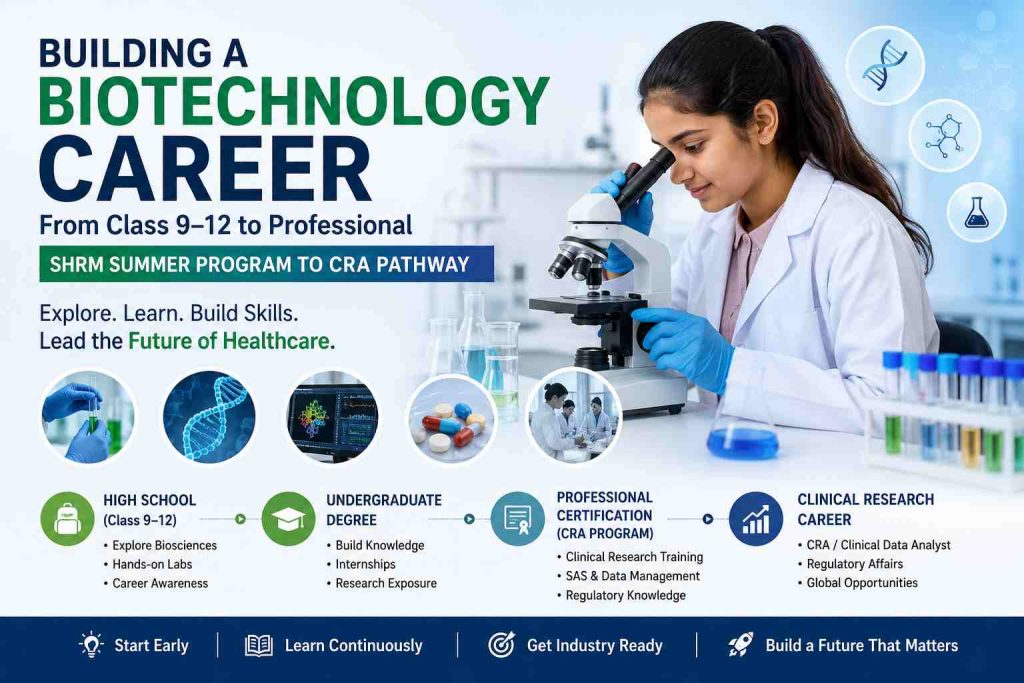
It develops step by step:
- Early exploration during school
- Skill-building during college
- Specialization through industry training
- Transition into professional careers
The SHRM Biosciences Summer Program 2026 gives high school students a valuable early introduction to biotechnology and research.
Later, the CRA Certification Course helps graduates and postgraduate candidates move toward real careers in clinical research and the pharmaceutical industry.
For students interested in biology, healthcare, medicine, pharmacy, or biotech, that combination can become a very strong long-term career pathway.
Author Bio: Tanmoy Ray is an admission consultant, content strategist, and former research scientist with a global academic portfolio. After earning his Master’s in the UK, he went on to work at the University of Oxford (UK), Utrecht University (Netherlands), and the University of New South Wales (Australia). He pivoted in 2015 into higher-education counselling and content marketing. Today, he helps students and professionals navigate admissions abroad while producing insight-rich content for career growth.