

In India, conducting research projects in high school is not that common. However, the trend is changing fast. Having changed careers from biomedical researcher to career and college adviser, I have seen the positive impact that well-planned independent or guided research can have on a high school student in a highly competitive college application environment.
In India, the current education system relies heavily on board exam performance, with grades dominating the discussion, but authentic independent research reflects intellectual curiosity, analytical abilities, and ownership of learning, attributes highly valued by leading public and private institutions like the University of California and Ivy League Schools.
Simply put, an independent research project doesn’t have to yield answers worthy of a Nobel Prize; however, an independent research project will demonstrate to your potential college/university how you’ve engaged with your research topic, gone in depth with the literature around your research topic, and provided an original analysis that demonstrates to the reader the true potential of the candidate.
What Exactly is an Independent Research Project?
An independent research project is a student-led investigation into a genuine, focused scientific question. It goes far beyond school assignments or generic science-fair models. You identify a knowledge gap, review existing literature, design a feasible methodology, gather and analyse data (wet-lab, computational, or review-based), draw conclusions, and produce a professional output, which could be a report, poster, or publication.
At the high school level, “original” doesn’t mean Nobel-level discovery. It means demonstrating intellectual ownership: asking a specific, answerable question, engaging deeply with sources, and showing your own analysis. In biosciences, this could mean “Antibiofilm activity of specific phytocompounds against Pseudomonas aeruginosa” or “In-silico docking studies on a protein target in Huntington’s disease.”
Why High School Research Gives You a Massive Advantage (Especially for College Admissions)
Admissions officers at selective universities — particularly the University of California system, Ivies, and research-intensive institutions — look for intellectual vitality and evidence that you can contribute meaningfully in a college environment.
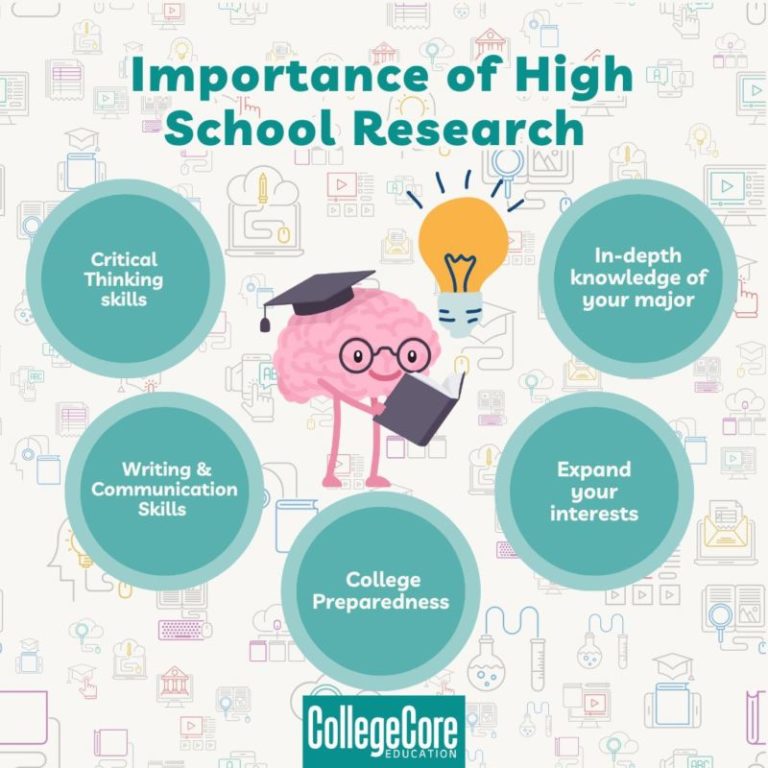
A strong research project signals sustained effort, critical thinking, resilience, and alignment with your intended major.
Key benefits of conducting research in high school:
- Admissions Edge: Research experiences correlate strongly with higher acceptance rates at top schools. Colleges value one meaningful, student-owned project far more than multiple shallow activities.
- Skill-Building: Literature review, experimental design, data analysis, scientific writing, and presentation skills — competencies that go well beyond rote learning.
- Career Clarity: Many students discover their true passion (or rule out paths) during the process.
- Publications & Recognition: With proper guidance, high schoolers regularly publish in reputable journals — a standout achievement on applications and CVs.
- Long-term Confidence: The process builds resilience and communication skills that benefit every future endeavour.
Read more about What Colleges Are Actually Looking For While Evaluating Research in High School.
How to Conduct Research as a High School Student in India
Indian students face real constraints — heavy board syllabi, limited lab access, and fewer structured mentorship options.
Here is a practical roadmap for pursuing research work while in high school:
- Choose a Passion-Driven, Focused Topic — Narrow it down to something specific and researchable within your resources.
- Conduct a Thorough Literature Review — Use Google Scholar, PubMed, and ResearchGate. Tools like Zotero help organise references.
- Refine Your Research Question — Make it specific, feasible, and interesting. Iterate after reading papers.
- Select a Practical Methodology — Wet-lab (if access available), in-silico/computational (using free tools like PyMOL, AutoDock, Python/R), systematic review, or hybrid. Document everything meticulously.
- Execute, Analyse & Present — Maintain detailed lab notebooks or logs. Use basic statistics. Prepare posters or presentations.
- Aim for Tangible Output — School/college events, conferences, or student-friendly journals. Publication is excellent but not mandatory.
Summers or early Class 11 are ideal windows. Structured programmes help balance research with board exam preparation.
How SHRM Biotechnologies Makes High School Research Accessible and Impactful
SHRM Biotechnologies offers well-designed School Research-Based Assignments — structured 12–16 week programmes where students undertake genuine investigations under expert mentorship.
You’ll work on real scientific questions, validate findings through laboratory or advanced computational methods, produce a professional report aligned with current literature, and present your work.
Their Bioscience Summer Program (now available online + offline in Kolkata and Gurgaon) provides excellent hands-on training in molecular biology, bioinformatics, and lab techniques — a natural stepping stone into longer research projects.
Key advantages:
- State-of-the-art lab facilities with personalised guidance
- Mentors experienced in high-school-level publications
- Flexible online/offline formats
- Strong support for both experimental and computational research
- Clear pathway to presentations and recommendation letters
For complete details, visit the School Research-Based Assignments page.
Research Projects in High School Success Stories at SHRM Biotech
Gidugu Bhargavi Lakshmi (Ekya School, Bengaluru) completed two in-silico research projects on antibiofilm activity and protein interactions in tuberculosis. Both were published in international journals, helping her secure admission to the University of California, Santa Cruz.
Naysa Srivastava worked on a novel drug-targeting approach for Huntington’s disease and a review of neurological genetic disorders. Her published work supported strong applications to top US universities, including the University of Illinois at Urbana-Champaign.
Many more SHRM students have published on diverse bioscience topics. Explore their full journeys on the Success Stories page.
Ready to Start Your Independent Research Journey?
High school research is not reserved for prodigies — it is for any motivated student ready to go beyond textbooks. With the right guidance, it becomes a transformative experience that strengthens college applications and builds lifelong skills.
If you’re serious about bioscience research, SHRM Biotechnologies is an excellent platform to explore. Connect with them directly for the Summer Program or a dedicated research project.
For any assistance or queries, please feel free to contact us.
Author Bio: Tanmoy Ray is an admission consultant, content strategist, and former research scientist with a global academic portfolio. After earning his Master’s in the UK, he went on to work at the University of Oxford (UK), Utrecht University (Netherlands), and the University of New South Wales (Australia). In 2015, Tanmoy pivoted into higher-education counselling and content marketing. Today, he helps students and professionals navigate admissions abroad while producing insight-rich content for career growth.